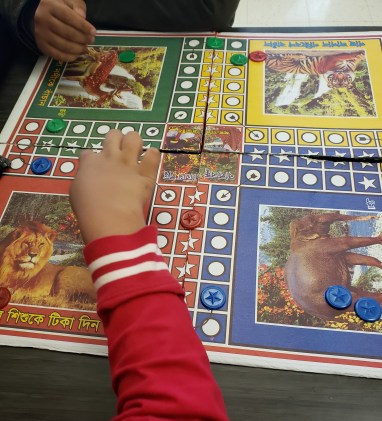
Student playing a board game at lunchtime.
Every year, there seems to be a class that gets a bad rap-“that class,” which teachers say is tough to teach. Recently a few teachers met with me about this year’s “tough class.”
The teacher’s solution: they wanted to invite the students’ parents into the classrooms to witness how the students were behaving.
I was surprised: why would the teachers want the parents to see the kids behaving badly? In fact, wouldn’t the kids just be good on that day? “Well,” said one teacher, “if the kids are good, then we can say, ‘See, you were good when your parents came in so why can’t you be this good everyday?’”
I remembered my first years of teaching middle school. When I struggled with a student, I would call parents about the problem. In hindsight, I see that I was asking—and actually wishing for– the parents to solve the problem. But in fact, the problem was mine.
My answer to the teachers’ request was no.


 A friend was recently telling me about his experience when he was a child in the 5th grade. “I used to get in trouble before the 5th grade. But my 5th grade teacher, she liked me. It was like, she never expected me to do anything bad. So I didn’t.”
 I once visited a principal who greeted his students as they walked in the front door of his school. He told me, “I solve 90% of my school’s discipline problems by standing here, greeting each student. I notice who’s smiling and who seems to be upset, and I stop them, talk to them, see if I can intervene and catch the problem before they walk into their classes.”
 As our nation discusses the idea of arming teachers, I’ve been thinking about a teacher’s ability to see and hear the many things happening in a classroom.

 Classroom 325