I could do this job until I’m 90

20181104_114211.jpgBeing a high school principal is not glamorous.  Case in point: last week, there were way too many chicken nuggets on the student cafeteria floor.  Note to ourselves: re-teach cafeteria cleanup.

Chicken nuggets included, I love my job and would choose no other.  This week, as I watched a staff trainer work with a student, I realized my experience is unusual.

I hired the trainer to show my staff effective ways to coach students through challenges. I watched the trainer talk to a student named Samantha, who was struggling.  The trainer was skillful in getting Samantha to engage in the conversation.

Then the trainer said, “Samantha, I know you’re not excited to come to school today.  In fact, I don’t think any of us were excited to come to work.  Even I had to make myself get up this morning.  None of us really want to be at work.”

Wait a second, I thought.  Really?  Continue reading

How to be a man

Sky view

This year, my school is focusing on raising the achievement of boys. I’ve learned that supporting boys goes beyond good teaching: we need to show boys more options for how to “be a man.”

Most boys have an idea of what it is to be a man. It’s often a child’s idea of being “hard” or “tough,” “independent.” A principal colleague of mine said he and his staff consciously teach their 9th graders to lose the “tough guy” attitude and just be kids; be students.

This week, I found myself in a conference with a student, Hassan,* and one of my teachers, Matt. Hassan had hit another student who had been calling him a “little boy” and making teasing gestures towards him.

In the past, we might have said, “The next time someone teases you, tell a teacher or administrator.” However, we saw that an 18-year-old boy who sees himself as a man may not want to run to a teacher to solve his problems.

Continue reading

I’m here, and I hear you

20180818_170636.jpg

Student artwork sale at the High School of Language and Innovation

I remember my first interview for a teaching position in August 2000, part of the first cohort of New York City Teaching Fellows.  I was standing in line at a hiring fair at the Brooklyn Marriott Hotel.

When I got to the front of the line, a harried-looking man introduced himself as a district representative hiring for a position teaching 8th grade in a middle school in Brooklyn. Continue reading

My partners in the “demo”

20180803_095018.jpg

At the High School of Language and Innovation, part of our teacher hiring process is having the candidate deliver a 15-minute demonstration lesson (a “demo”) in front of one of our classes. A candidate can nail an interview but the demo is often the most telling part of the process because we see what the person would be like in front of real students.

I wrote in an earlier blog about the comparatively low number of Latino boys in my school who are graduating on time. When I expressed this concern to my leadership consultants Ariel and Shya Kane, they suggested that in every demo lesson, we include a significant number of Latino boys and take special note of how the teacher engages those boys. This suggestion has been invaluable– rather than looking narrowly for a certain “type” of candidate, we’ve shifted to simply seeing who our students become in front of that candidate.

Since summer school classes are smaller, we have sometimes needed to add boys from other classes.

Continue reading

Sitting alone in the cafeteria

20180406_181850.jpgNothing makes me sadder than a kid sitting alone in the cafeteria.  Sometimes, a student is sitting alone by choice—he or she simply prefers to be alone, perhaps reading a book, or taking a break from interaction.
Other times, a student sits alone because he or she is new, and is the only person who speaks his or her own language.  The High School of Language and Innovation is a school for newcomer English Language Learners.  Most new students that have a large same-language, same-culture group—Spanish, Arabic, Bengali, Albanian, French—will be quickly adopted into the group.  If a student speaks a language like Vietnamese or Chinese, which are both small populations in our school, they might be alone if their 1-2 compatriots are absent.   Continue reading

Graduating the boys

20180628_062512.jpg

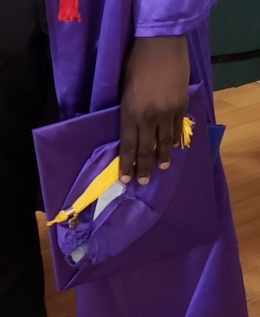
My school, the High School of Language and Innovation, is a school for newcomer immigrant English Language Learners that was founded in 2011. We had our first graduating class in 2015. This week, we graduated our fourth class, the class of 2018.

As I listened to the students’ speeches at graduation, I was struck by how many of the students had experienced our intended vision for the school: “We learned to work together as a team in order to learn English,” “We got to make friends with people from diverse cultures.”

However, even as I enjoyed the graduation, something was on my mind: 90% of our girls graduated. 51% of our boys graduated.*

Continue reading

Contained Curiosity

20161114_095515.jpg

After-school drumming class.

A month ago, our school transformed at lunchtime.  Our noisy, boisterous cafeteria became almost quiet.  Half of the tables were empty.

It was the beginning of Ramadan and a large number of our students were fasting.  Some fasting students still chose to go to the cafeteria.  Many more stayed in classrooms supervised by teachers, away from the smell of food, playing chess, using computers, doing homework, or just sitting and chatting with one another.

About 40% of our students are Muslim.  Continue reading

Why do you want to work in this school?

20180608_064202.jpgMy school is in the process of interviewing prospective teachers for the next school year.  Last week I wrote about a question we ask prospective teachers about feedback.

There is another important question we ask at the end of each interview:

“Why do you want to work in this school?”

This question tells us a lot about a teacher’s commitment to teaching our population of newcomer English Language Learners, as well as how much they’ve researched our school and what they like about it.

I’ve recently been considering my answer to this question.  Why do I want to work in my school?  Continue reading

A piece of the puzzle at prom

20180511_065917.jpg

I’m always surprised by how much I learn about our school from our prom. We recently held our prom earlier than most schools due to Ramadan, as we wanted more of our Muslim students to be able to attend.

Our high school is a school for newcomer English Language Learners from all over the world who have been in the USA less than 4 years. The students are excited by the idea of the prom but they don’t have a strong expectation of what it should be so there’s no comparison or disappointment.

Continue reading